Certified Scrum Professional ScrumMaster (CSP-SM) Training Certification
Certified Scrum Professional ScrumMaster (CSP-SM) Training Certification is designed for senior Scrum Masters to master advanced Agile practices. CSP-SM certification helps professionals to improve leadership skills, drive organizational agility and deliver high impact Scrum outcomes consistently.

Key Features
- 2 Days of Online Live Virtual Class
- Two-year membership in Scrum Alliance
- Get trained by globally acclaimed Certified Scrum Trainer (CST)
- 20 PDUs and SEUs
- No Exam, Direct Certification
- 100% Money Back guarantee
Our Contacts
For any queries & discount please contact
Meghana : +91-7892945526
Happy : +91-9148370043
Drop us your query on - trainings@poweragile.com
For Corporate Training
( Business, teams or Group of Learners)
Our Upcoming Trainings Calendar
Get In Touch With Us
Overview of CSP-SM Certification Training
Overview of CSP-SM Training Certification focuses on developing advanced leadership and facilitation capabilities for experienced Scrum Masters working in complex Agile environments. CSP-SM Training Certification is designed for professionals. It helps them to move beyond basic Scrum practices and drive real organizational agility. The CSP-SM program emphasizes practical learning experiential exercises and deep understanding of Scrum values while aligning teams with business outcomes. It represents the highest level of Scrum Master growth under the Certified Scrum Professional®(CSP-SM) pathway.
CSP-SM Training Certification matters in modern Agile organizations, because companies now expect Scrum Masters to act as change agents rather than process coordinators. Organizations face challenges such as scaling Agile, managing cross functional teams and aligning leadership with Agile thinking. CSP-SM Training Certification equips professionals with skills to coach stakeholders, resolve systemic impediments and enable continuous improvement at team and enterprise levels. It makes them critical contributors to Agile transformation success.
The Scrum Master role has evolved significantly over time. Initially focused on ceremonies and rule enforcement it has grown into a leadership role centered on coaching mentoring and organizational influence. Today Scrum Masters are expected to support product strategy, foster collaboration and guide cultural change. CSP-SM Training Certification reflects this evolution by preparing practitioners for higher responsibility and broader impact.
Industry demand for CSP-SM professionals continues to rise as enterprises adopt Agile frameworks across domains such as IT finance, healthcare and manufacturing. Employers value CSP-SM Training Certification. It demonstrates proven experience, advanced knowledge and commitment to professional excellence. Certified Scrum Professional®(CSP-SM) holders often access senior roles with higher credibility and better career opportunities.
CSP-SM Training Certification is ideal for experienced Scrum Masters Agile coaches, project managers and product leaders. It also helps you to those, who already practice Scrum and want to deepen their influence. It is especially suitable for professionals aiming to lead Agile transformations, mentor teams and shape Agile culture within organizations.
Eligibility
Certified Scrum Professional- Scrum Master® (CSP-SM®) Certification Is Suitable For:
1)Software Engineers
2) Business Analysts
3) Project Managers
4) New Scrum Team Members
5) Product Owners
6) Agile Coaches
7) Team Leads
8) Coaches
Benefits
1. Builds practical Agile leadership skills
2. Strengthens effective Scrum facilitation expertise
3. Improves team collaboration and delivery outcomes
4. Cultivates strong coaching and mentoring mindset
5. Extends organizational leadership influence
6. Promotes continuous improvement culture mindset
7. Improves stakeholder alignment and communication
8. Builds confidence handling complex Agile scenarios
9. Supports creation of self managed teams
10. Career recognition through CSP-SM Training Certification and Certified Scrum Professional®(CSP-SM)
Why Get CSP-SM Certified?
1. No formal examination process
2. Validation from Scrum Alliance
3. Simple online certificate download
4. Educator led practical learning
5. Focus on real world skills
6. Advanced Scrum Master credibility
7. Recognition as Certified Scrum Professional®(CSP-SM)
8. Strong career growth potential
9. Alignment with industry Agile standards
10. Two year CSP-SM Training Certification validity
CSP-SM Course Pre-requisites
1. Prior advanced Scrum level certification
2. Hands on Scrum Master experience
3. Clear understanding of Scrum principles
4. Regular participation in Agile teams
5. Proven use of Scrum practices
CSP-SM Training Certification for Organizations
CSP-SM Training Certification for Organizations is a strategic investment for enterprises. It helps you to strengthen Agile maturity and sustain long term performance. CSP-SM Training Certification focuses on developing experienced Scrum Masters into influential Agile leaders. It helps you to guide teams and organizations through complexity. Instead of limiting learning to frameworks and ceremonies the CSP-SM training builds deep understanding of systems thinking collaboration and continuous improvement. Organizations benefit by creating internal capability rather than depending on external consultants.
One of the key benefits for teams and enterprises is improved alignment between delivery goals and business priorities. CSP-SM Training Certification equips professionals to remove organizational impediments and enable smoother workflows. Teams gain clarity in roles, responsibilities and expectations which reduces friction and increases focus. Enterprises experience better coordination across departments leading to more consistent outcomes.
Improving delivery predictability is another major advantage. Trained CSP-SM professionals help teams to analyze bottlenecks, refine planning practices and use data driven insights. This results in more reliable forecasting stable sprint outcomes and reduced last minute surprises. Leadership gains confidence in timelines. It also helps teams to work with realistic commitments and sustainable pace.
Enhancing team engagement is a critical outcome of CSP-SM Training Certification. Certified Scrum Professional®(CSP-SM) practitioners foster trust, psychological safety and open communication. Teams feel empowered to self organize, share ideas and take ownership of results. Higher engagement leads to better morale, lower attrition and improved quality of work across the organization.
Driving business agility is essential in fast changing markets. CSP-SM Training Certification enables organizations to respond quickly to customer needs, market shifts and innovation opportunities. Scrum Masters trained at this level act as change facilitators helping leadership adopt Agile thinking beyond teams. This also creates flexibility in decision making and faster value delivery.
Building internal Agile leadership is a long term benefit for organizations. CSP-SM Training Certification develops leaders, who can mentor teams, coach managers and influence culture. These professionals become role models for Agile values and practices ensuring consistency across initiatives.
The long term organizational impact includes stronger resilience, continuous learning and sustainable growth. Organizations with CSP-SM Training Certification capability build a culture. It helps you to embrace improvement, collaboration and adaptability, positioning themselves for lasting success in competitive environments.
Career Growth with CSP-SM Training Certification
Career Growth with CSP-SM Training Certification opens strong professional opportunities for experienced Agile practitioners. It helps them to move into influential and strategic roles. CSP-SM Training Certification represents advanced mastery of Scrum leadership coaching and organizational agility. It signals that a professional is capable of handling complex team dynamics and enterprise level challenges. This recognition helps individuals to stand out in competitive Agile job markets.
Career paths for CSP-SM certified professionals extend far beyond traditional Scrum Master positions. Many professionals move into senior Scrum Master roles where they support multiple teams and large initiatives. Others transition into Agile program support roles contributing to scaling efforts and cross team coordination. CSP-SM Training Certification validates readiness for these advanced career directions.
Role expansion beyond Scrum Master is a natural outcome of this certification. Certified Scrum Professional®(CSP-SM) practitioners often take responsibility for mentoring junior Scrum Masters facilitating leadership workshops and influencing product strategy. They work closely with management to align Agile practices with business goals creating value at both team and organizational levels.
Agile coaching career opportunities significantly increase with CSP-SM Training Certification. Organizations seek professionals. It also helps coach team leaders and stakeholders through mindset and behavior change. CSP-SM professionals apply coaching techniques to improve collaboration, resolve conflicts and foster continuous improvement. It makes them ideal candidates for internal or external Agile coaching roles.
Leadership roles enabled by CSP-SM Training Certification include Agile lead transformation lead and delivery manager positions. Professionals with the CSP-SM certification are trusted to guide change initiatives and support executive decision making. Their ability to balance people process and outcomes positions them as credible leaders in Agile transformations.
Salary growth and market demand are strong benefits associated with CSP-SM Training Certification. Employers recognize the advanced expertise and practical experience behind the CSP-SM credential. As a result CSP-SM certified professionals often command higher compensation and faster career progression compared to peers without advanced certification.
Global recognition and credibility further enhance career growth. CSP-SM Training Certification and Certified Scrum Professional®(CSP-SM) are respected worldwide. It makes it easier to access international opportunities. This global acceptance strengthens professional confidence and long term career mobility.
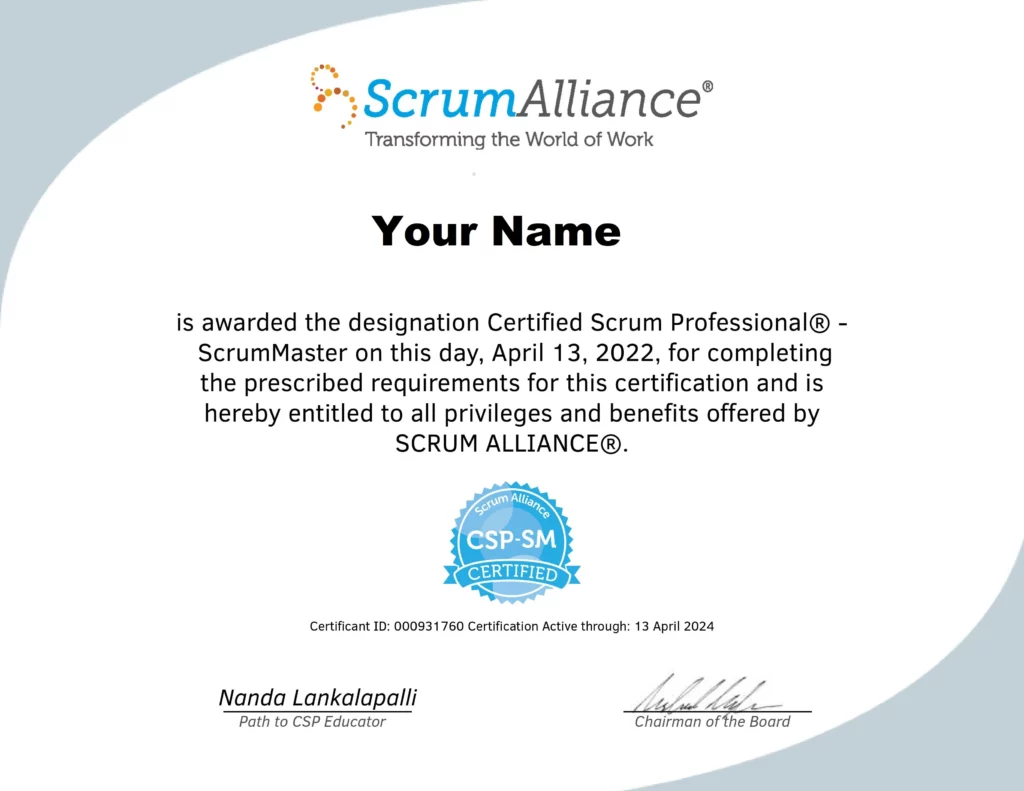
CSP-SM Sample Certificate
Continuous Learning after CSP-SM Training Certification
Continuous Learning after CSP-SM Training Certification is essential for professionals who want to remain effective in dynamic Agile environments. CSP-SM Training Certification represents advanced capability but Agile practices continue to evolve with changing business needs technology and team structures. Ongoing learning ensures that certified professionals stay adaptable, reflective and impactful in their roles. It transforms certification from a milestone into a long term professional journey.
The importance of lifelong learning becomes clear as organizations face new challenges such as distributed teams scaling complexity and rapid innovation cycles. CSP-SM Training Certification provides a strong foundation. Its continuous learning helps professionals to deepen systems thinking, coaching skills and leadership effectiveness. This mindset encourages curiosity, experimentation and regular self improvement which are core Agile values.
Agile communities and networking play a significant role in continuous growth. Certified Scrum Professional®(CSP-SM) practitioners actively participate in local and global Agile communities to exchange insights and real world experiences. Conferences, meetups, online forums and learning circles provide exposure to diverse perspectives and emerging practices. These connections help professionals to learn from successes and failures beyond their own organizations.
Mentoring other Scrum professionals is another powerful learning path. CSP-SM Training Certification holders often support junior Scrum Masters and Agile practitioners by sharing knowledge and practical guidance. Mentoring reinforces learning through reflection. It also helps you to build leadership credibility. It also strengthens the overall Agile capability within teams and organizations.
Advanced workshops and learning paths further expand expertise after CSP-SM Training Certification. Professionals explore topics such as enterprise agility facilitation mastery leadership coaching and organizational change. These learning experiences help to refine advanced skills and prepare individuals for broader responsibilities in complex environments.
Staying relevant in evolving Agile practices is a continuous effort. New frameworks, tools and approaches emerge as organizations adapt Agile principles to different industries. CSP-SM Training Certification professionals stay current by experimenting with practices inspecting outcomes and adapting approaches to context.
Continuous learning ensures that CSP-SM Training Certification remains meaningful over time. It supports sustained professional growth, stronger impact and long term value creation. By committing to learning Certified Scrum Professional®(CSP-SM) practitioners continue to lead with confidence, relevance and purpose.
Real World Application of CSP-SM Training Certification
Real World Application of CSP-SM Training Certification demonstrates how advanced Scrum Master capabilities translate into measurable business outcomes. CSP-SM Training Certification emphasizes practical learning. It can be applied directly in real projects across diverse organizational contexts. Professionals use this knowledge to address challenges beyond basic Scrum execution and support sustainable Agile adoption. The focus is on turning theory into action within day to day work environments.
Applying learning in real projects begins with observing team dynamics and identifying systemic impediments. CSP-SM Training Certification helps professionals to facilitate meaningful conversations, improve collaboration and enable teams to self organize effectively. Scrum Masters apply coaching techniques to guide teams through planning reviews and retrospectives with greater purpose. These practical applications lead to improved delivery quality and stronger ownership.
Case studies from various industries highlight the versatility of CSP-SM Training Certification. In technology organizations it supports faster product releases and improved cross team alignment. In finance and healthcare environments CSP-SM professionals help to balance regulatory constraints with Agile principles. Manufacturing and service industries benefit from improved workflow transparency and continuous improvement. These examples show how Certified Scrum Professional®(CSP-SM) practices adapt to different business realities.
Handling complex organizational scenarios is a key strength developed through CSP-SM Training Certification. Professionals learn to work with resistance from leadership, navigate cultural barriers and manage dependencies across teams. They apply facilitation and conflict resolution skills to create alignment and trust. It enables organizations to move forward even in uncertain and high pressure situations.
Lessons from successful Scrum transformations emphasize leadership support, clear vision and consistent coaching. CSP-SM Training Certification practitioners help organizations to focus on mindset change rather than only process adoption. They encourage experimentation feedback and learning which leads to sustainable transformation rather than short term compliance.
Common mistakes and learning opportunities also shape real world application. Organizations often expect quick results or treat Scrum as a rigid process. CSP-SM Training Certification teaches professionals to address these misconceptions through education and example. Learning from setbacks strengthens expertise and builds resilience.
Through real world application CSP-SM Training Certification delivers lasting value. Certified Scrum Professional®(CSP-SM) practitioners become trusted partners in transformation creating meaningful impact across teams and organizations.
CSP-SM Training Certification Assessment Approach
CSP-SM Training Certification Assessment Approach is designed to evaluate real capability rather than theoretical knowledge. CSP-SM Training Certification follows an assessment based certification model. It focuses on how professionals apply Scrum Master skills in practical situations. This approach ensures that certification represents true expertise and readiness to operate in complex Agile environments. It emphasizes learning outcomes, behaviors and impact over traditional exam scores.
The assessment based certification model encourages active participation and reflection throughout the learning journey. Instead of a single test candidates demonstrate understanding through exercises, discussions and real scenarios. CSP-SM Training Certification values consistent engagement and evidence of growth which aligns with Agile principles of inspection and adaptation. This model builds confidence and accountability in certified professionals.
Trainer evaluation methods play a critical role in the assessment process. Approved educators observe participants during workshops, simulations and collaborative activities. They assess facilitation quality coaching approach and problem solving ability. Trainers provide structured feedback that highlights strengths and identifies areas for improvement. This ongoing evaluation ensures that learners meet the high standards expected of Certified Scrum Professional®(CSP-SM).
Peer feedback mechanisms further strengthen the assessment approach. Participants will review each other’s contributions during group activities and discussions. Peer feedback encourages self awareness, collaboration and learning from diverse perspectives. It mirrors real workplace dynamics. Here Scrum Masters continuously interact with teams and stakeholders.
Demonstration of Scrum Master competencies is central to CSP-SM Training Certification. Candidates show proficiency in servant leadership conflict resolution team facilitation and impediment management. These demonstrations validate the ability to guide teams and influence organizational change. Competency demonstration ensures certification reflects practical mastery rather than attendance alone.
Real world application assessment connects learning directly to workplace impact. Participants will apply concepts in their own organizations and reflect on outcomes, challenges and lessons learned. It ensures CSP-SM Training Certification remains relevant and grounded in actual professional practice.
Continuous learning validation completes the assessment approach. Learners are encouraged to inspect progress, seek feedback and refine skills even after certification. CSP-SM Training Certification and Certified Scrum Professional®(CSP-SM) thus represent ongoing commitment to excellence learning and real world Agile leadership.
Leadership Development through CSP-SM Training Certification
Leadership Development through CSP-SM Training Certification focuses on building leaders who enable teams rather than control them. CSP-SM Training Certification develops advanced leadership capabilities aligned with Agile values and people centric practices. It prepares professionals to guide teams, organizations and stakeholders through complexity. It helps you to maintain focus on collaboration and continuous improvement. Leadership in this context is about influence, service and responsibility rather than formal authority.
Servant leadership principles form the foundation of CSP-SM Training Certification. Professionals learn to prioritize team needs, remove obstacles and create an environment. Here individuals can perform at their best. By serving teams first Scrum Masters encourage ownership accountability and self organization. This approach strengthens engagement and drives sustainable performance.
Situational leadership in Agile teams is another key focus. CSP-SM Training Certification teaches leaders to adapt their style based on team maturity challenges and context. Sometimes teams need guidance, while at other times they require autonomy and trust. Understanding when to coach, facilitate or step back enables Scrum Masters to support teams effectively.
Influencing without authority is a critical skill developed through CSP-SM Training Certification. Scrum Masters often work across hierarchies without direct control. Professionals learn facilitation negotiation and coaching techniques to influence decisions and behaviors. It allows Certified Scrum Professional®(CSP-SM) practitioners to drive change through respect, credibility and collaboration.
Building trust and credibility is essential for effective leadership. CSP-SM Training Certification emphasizes transparency, consistency and ethical behavior. Leaders who listen actively follow through on commitments and support open communication earn trust from teams and stakeholders. Trust creates psychological safety which is vital for innovation and learning.
Leading through change is a constant requirement in Agile environments. CSP-SM Training Certification equips professionals to guide teams through uncertainty resistance and transformation. Leaders learn to communicate purpose, manage emotions and sustain momentum during change initiatives.
Ethical leadership in Scrum environments is also emphasized. CSP-SM Training Certification encourages integrity, fairness and respect in decision making. By modeling ethical behavior Certified Scrum Professional®(CSP-SM) leaders create cultures of accountability, inclusion and long term success.
Core Principles of CSP-SM Training Certification
Core Principles of CSP-SM Training Certification define the foundation on which advanced Scrum Master expertise is built. CSP-SM Training Certification emphasizes mindset values and behaviors. It enables sustainable Agile success. These principles guide professionals in making informed decisions supporting teams and driving continuous improvement across organizations. They move beyond mechanics and focus on why Agile works in complex environments.
Agile values and principles are central to CSP-SM Training Certification. Professionals deepen their understanding of collaboration, customer focus, adaptability and respect for individuals. The CSP-SM training reinforces commitment to delivering value through iterative learning and responsiveness to change. By living these values Scrum Masters help teams to align daily work with broader organizational goals.
Scrum theory and empirical process control form another key principle. CSP-SM Training Certification strengthens understanding of empiricism which is based on experience observation and experimentation. Scrum Masters learn how to apply theory to real situations and guide teams in making evidence based decisions. It ensures that processes remain flexible and responsive rather than rigid.
Transparency inspection and adaptation are essential pillars within CSP-SM Training Certification. Professionals learn to create transparency through clear communication, visible work and shared understanding. Inspection enables teams to evaluate progress, identify issues and learn from outcomes. It also allows timely adjustments that improve results and reduce risk. Together these practices support continuous learning and improvement.
Professional accountability is strongly emphasized in CSP-SM Training Certification. Certified Scrum Professional®(CSP-SM) practitioners take responsibility for upholding Scrum values and ethical standards. They are accountable for their actions, decisions and impact on teams and organizations. This accountability builds trust and credibility while reinforcing professionalism.
CSP-SM Training Certification also encourages self accountability and reflection. Professionals regularly assess their effectiveness, seek feedback and commit to growth. This mindset supports long term mastery and resilience in changing environments.
Servant Leadership in CSP-SM Training Certification
Servant Leadership in CSP-SM Training Certification is a core concept that shapes how advanced Scrum Masters support teams and organizations. CSP-SM Training Certification emphasizes leadership as service. Here the focus is on enabling others to succeed. Instead of directing or controlling servant leaders create conditions. It allows teams to thrive, perform and continuously improve. This approach aligns strongly with Agile values and sustainable delivery.
The concept of servant leadership within CSP-SM Training Certification is rooted in humility, trust and shared responsibility. Scrum Masters learn to place team needs above personal authority. They focus on facilitating collaboration, fostering ownership and encouraging learning. By serving teams first leaders help individuals to grow in confidence capability and accountability which strengthens overall performance.
The role of empathy and listening is critical in servant leadership. CSP-SM Training Certification trains professionals to listen actively, understand different perspectives and respond with compassion. Empathy helps Scrum Masters identify underlying issues such as conflict stress or lack of clarity. Effective listening builds trust and psychological safety allowing teams to communicate openly and address challenges constructively.
Empowering self managing teams is a major outcome of servant leadership. CSP-SM Training Certification enables professionals to coach teams toward autonomy and shared decision making. Instead of solving problems for the team, Scrum Masters guide them to find their own solutions. This empowerment leads to higher engagement, stronger ownership and faster learning. Self-managing teams adapt quickly and deliver consistent value.
Removing impediments at scale is another essential responsibility developed through CSP-SM Training Certification. Servant leaders look beyond team level obstacles to identify organizational and systemic barriers. They work with leadership and stakeholders to address policies, structures or behaviors that hinder progress. By removing these impediments Scrum Masters create an environment where multiple teams can succeed simultaneously.
Through servant leadership CSP-SM Training Certification develops leaders, who influence through trust and service. Certified Scrum Professional®(CSP-SM) practitioners model ethical behavior, empathy and accountability.
Coaching Techniques Covered in CSP-SM Training Certification
Coaching Techniques Covered in CSP-SM Training Certification are designed to help Scrum Masters to move from directive behavior to true coaching leadership. CSP-SM Training Certification focuses on developing the ability to guide teams and individuals toward their own solutions. These techniques support long term learning ownership and continuous improvement rather than short term problem solving. Coaching becomes a daily practice that strengthens Agile culture.
A professional coaching mindset is the foundation of CSP-SM Training Certification. Professionals learn to shift from giving answers to creating awareness and responsibility. This mindset emphasizes curiosity, openness and respect for the capability of others. By trusting teams and individuals Scrum Masters encourage growth, confidence and accountability. The coaching mindset also helps leaders remain neutral, supportive and focused on outcomes.
Powerful questioning techniques are a key component of CSP-SM Training Certification. Scrum Masters learn to ask open ended questions that provoke reflection, insight and learning. Instead of leading questions that suggest solutions, powerful questions help teams explore options, understand constraints and make informed decisions. This approach supports better problem solving and strengthens team ownership.
Active listening skills are essential for effective coaching. CSP-SM Training Certification trains professionals to listen beyond words by observing tone, emotion and body language. Active listening helps Scrum Masters to fully understand challenges before responding. It also signals respect and builds trust. When people feel heard they are more open to feedback, collaboration and change.
Feedback and growth conversations are another important area covered in CSP-SM Training Certification. Professionals will learn here how to deliver feedback that is timely, constructive and focused on development. They practice facilitating growth conversations that balance appreciation with improvement. These conversations help individuals and teams recognize strengths, address gaps and set clear improvement goals.
By integrating these coaching techniques CSP-SM Training Certification enables Scrum Masters to support sustainable performance and continuous learning. Certified Scrum Professional®(CSP-SM) practitioners use coaching skills to empower teams, strengthen relationships and create environments.
Facilitation Mastery in CSP-SM Training Certification
Facilitation Mastery in CSP-SM Training Certification equips Scrum Masters with advanced skills to guide meaningful conversations and collaborative outcomes. CSP-SM Training Certification emphasizes facilitation as a core leadership capability that directly impacts team effectiveness and delivery quality. Rather than simply running meetings, professionals learn how to design and guide interactions that create clarity, alignment and shared ownership.
Designing effective Scrum events is a primary focus of facilitation mastery. CSP-SM Training Certification helps professionals to plan Sprint Planning Reviews Retrospectives and Daily Scrums with clear purpose and outcomes. Scrum Masters learn how to select appropriate facilitation techniques, set expectations and manage time effectively. Well designed events encourage participation, foster transparency and drive actionable improvements.
Managing conflict constructively is another essential facilitation skill developed through CSP-SM Training Certification. Conflict is natural in collaborative environments and when handled well it leads to better decisions and innovation. Professionals learn to surface issues respectfully, balance diverse perspectives and guide teams toward resolution. Constructive conflict management strengthens trust and psychological safety.
Facilitating large groups and multiple teams requires advanced capability. CSP-SM Training Certification prepares Scrum Masters to work across teams, departments and programs. Professionals learn techniques for scaling conversations, managing dependencies and aligning multiple stakeholders. It also enables smoother collaboration and shared understanding in complex organizational settings. Certified Scrum Professional®(CSP-SM) practitioners become effective facilitators at both team and enterprise levels.
Remote and hybrid facilitation strategies are increasingly important in modern workplaces. CSP-SM Training Certification covers methods to engage distributed teams using digital tools and structured interaction. Professionals learn how to maintain energy participation and focus in virtual settings. Effective remote facilitation ensures inclusivity and collaboration regardless of location.
Through facilitation mastery CSP-SM Training Certification enables Scrum Masters to create environments where teams think together, decide together and improve together. Certified Scrum Professional®(CSP-SM) practitioners use facilitation to enable transparency learning and alignment.
Assessment Process for CSP-SM Training Certification
The Assessment Process for CSP-SM Training Certification is designed to validate practical expertise rather than theoretical understanding alone. CSP-SM Training Certification follows an assessment based evaluation model that focuses on observable behaviors, real world application and demonstrated leadership skills. This process ensures that certification represents genuine capability and readiness to perform in complex Agile environments. It aligns closely with the principles of continuous learning and improvement.
The assessment based evaluation model emphasizes participation reflection and application throughout the CSP-SM training journey. Instead of a single examination candidates are assessed across multiple learning activities. CSP-SM Training Certification values how professionals think, respond and adapt in real scenarios. This approach encourages deeper learning accountability and consistent engagement.
Trainer feedback and observations are central to the assessment process. Approved educators closely observe participants during discussions, simulations and collaborative exercises. They evaluate facilitation style coaching approach problem solving ability and interaction with others. Trainers provide structured feedback. It helps learners to understand strengths and improvement areas. This feedback loop supports growth and ensures alignment with Certified Scrum Professional®(CSP-SM) standards.
Peer review mechanisms further strengthen the assessment process. Participants will give and receive feedback during group activities and reflections. Peer reviews promote self awareness, shared learning and openness to different perspectives. This mirrors real Agile environments. Here collaboration and feedback are continuous. Learning from peers helps professionals to refine their skills in a supportive setting.
Demonstration of competencies is a key requirement in CSP-SM Training Certification. Candidates demonstrate capabilities such as servant leadership conflict management facilitation and impediment removal. These demonstrations show how Scrum Masters apply knowledge in practice. Competency based assessment ensures that certification reflects real performance rather than attendance.
Overall the assessment process for CSP-SM Training Certification creates meaningful validation of professional mastery. Certified Scrum Professional®(CSP-SM) practitioners to emerge with confidence, credibility and practical capability. This assessment approach strengthens trust in the certification and ensures long term value for individuals, teams and organizations.
Role of Trainers in CSP-SM Training Certification
The role of Trainers in CSP-SM Training Certification is central to ensuring deep learning and professional growth. CSP-SM Training Certification relies on experienced educators, who go beyond content delivery to act as facilitators, coaches and mentors. Trainers shape how participants will understand and apply advanced Scrum Master practices in real organizational contexts. Their role directly influences the quality and credibility of the learning experience.
Trainer expectations within CSP-SM Training Certification are high. Trainers are expected to demonstrate advanced Scrum knowledge, strong facilitation skills and real world experience. They model Agile values and professional behavior throughout the CSP-SM program. By setting clear expectations and maintaining learning discipline trainers help participants to stay focused, engaged and accountable. It helps you to establish a strong foundation for meaningful learning.
Mentorship and guidance are key aspects of the trainer role. CSP-SM Training Certification trainers support participants to explore complex situations and challenges. They guide learners through reflection questioning and experimentation rather than providing direct answers. This mentorship approach helps professionals to develop independent thinking confidence and leadership capability. Certified Scrum Professional®(CSP-SM) trainers act as trusted guides on the learning journey.
Feedback driven improvement is another critical responsibility. Trainers continuously observe participant behavior interactions and decision making. They provide timely constructive feedback that highlights strengths and areas for growth. This feedback helps learners to adjust their approach and improve effectiveness. CSP-SM Training Certification uses feedback as a tool for continuous improvement aligned with Agile principles.
Learning environment creation is essential to successful outcomes. Trainers create safe inclusive and engaging spaces. Here participants will also feel comfortable sharing experiences and challenges. They encourage open dialogue respect diverse perspectives and promote collaboration. A strong learning environment supports experimentation learning from failure and mutual support.
Through these roles trainers ensure CSP-SM Training Certification delivers lasting value. Certified Scrum Professional®(CSP-SM) educators help learners to build confidence, competence and credibility.
Career Paths After CSP-SM Training Certification
Career Paths After CSP-SM Training Certification expand significantly for professionals. It helps them to move into influential and strategic Agile roles. CSP-SM Training Certification represents advanced mastery of Scrum leadership coaching and organizational agility. It signals readiness to work beyond single team boundaries and contribute to enterprise wide transformation initiatives. It opens diverse and rewarding career opportunities.
Agile Coach roles are a common path after CSP-SM Training Certification. Professionals support multiple teams leaders and stakeholders in adopting Agile mindset and practices. They focus on improving collaboration, addressing systemic challenges and fostering continuous improvement. CSP-SM Training Certification equips individuals with coaching facilitation and mentoring skills required to succeed as Agile Coaches in complex environments.
Enterprise Scrum Master roles are another prominent career option. In these positions professionals guide several Scrum teams and coordinate across programs or value streams. They help remove organizational impediments, align teams with strategic goals and support scaling efforts. Certified Scrum Professional®(CSP-SM) practitioners in enterprise roles influence delivery predictability and cross team collaboration at a broader level.
Transformation leadership positions become accessible with CSP-SM Training Certification. Professionals step into roles such as Agile transformation lead delivery lead or change leader. These roles involve guiding organizations through cultural process and structural change. CSP-SM Training Certification prepares leaders to work with executives, manage resistance and sustain momentum during large scale Agile adoption.
Consulting and mentoring opportunities also grow after CSP-SM Training Certification. Many professionals choose to work as internal consultants or independent advisors supporting multiple organizations. They mentor Scrum Masters product leaders and managers to build internal capability. Consulting roles allow Certified Scrum Professional®(CSP-SM) practitioners to apply expertise across industries and contexts.
Overall CSP-SM Training Certification creates flexibility in career progression. Professionals are no longer limited to facilitation focused roles but can influence strategy leadership and transformation. Certified Scrum Professional®(CSP-SM) credentials add credibility and global recognition. It enables long term career growth, diverse opportunities and meaningful impact across teams and organizations.
Common Challenges During CSP-SM Training Certification
Common Challenges During CSP-SM Training Certification often arise as professionals move from basic Scrum practices to advanced leadership and coaching roles. CSP-SM Training Certification requires a deep mindset shift and consistent application in real work environments. These challenges are a natural part of growth and often indicate meaningful learning is taking place.It helps learners to prepare and progress effectively.
Mindset shift difficulties are one of the most common challenges. Many professionals are accustomed to directive problem solving and control based leadership. CSP-SM Training Certification encourages a servant leader and coaching mindset which can feel uncomfortable at first. Letting go of authority and trusting teams requires self awareness, reflection and practice. Over time this shift leads to stronger engagement and better outcomes.
Balancing work and learning is another significant challenge. CSP-SM Training Certification demands time for workshops, reflection assignments and practical application. Professionals often juggle full time roles and personal commitments alongside learning. Effective time management prioritization and organizational support are essential to maintain momentum without burnout.
Applying concepts in real environments can also be difficult. Each organization has unique constraints such as hierarchy, culture and legacy processes. CSP-SM Training Certification concepts may initially face limitations in these contexts. Professionals must adapt practices thoughtfully rather than applying them mechanically. Experimentation patience and continuous feedback help to bridge the gap between learning and reality.
Overcoming resistance is a frequent challenge during CSP-SM Training Certification. Team managers or stakeholders may resist change due to fear of misunderstanding or past experiences. Certified Scrum Professional®(CSP-SM) practitioners learn to address resistance through empathy communication and education. Building trust and demonstrating value gradually reduces opposition.
Despite these challenges CSP-SM Training Certification offers strong support through trainer guidance, peer learning and reflection. Each challenge becomes a learning opportunity that strengthens capability and confidence. Certified Scrum Professional®(CSP-SM) professionals emerge more resilient, adaptable and prepared to lead change. Facing and overcoming these challenges is a key part of mastering advanced Scrum leadership.
Best Practices for CSP-SM Training Certification Success
Best Practices for CSP-SM Training Certification Success help professionals to gain maximum value from advanced learning experiences. CSP-SM Training Certification focuses on practical mastery, leadership growth and mindset development rather than rote knowledge. Following proven practices enables learners to engage deeply, apply insights effectively and achieve lasting professional impact. Success depends on preparation, participation and continuous reflection.
Preparing for advanced learning is the first important step. CSP-SM Training Certification builds on prior Scrum experience so professionals should refresh core Scrum concepts and reflect on real challenges they face at work. Entering the CSP-SM program with clear goals and openness to change helps learners absorb advanced ideas. Mental readiness and curiosity create a strong foundation for growth.
Engaging actively in sessions is essential for success. CSP-SM Training Certification emphasizes interaction discussion and experiential learning. Participants will benefit most. Here they will share experiences, ask questions and participate in exercises. Active engagement exposes learners to diverse perspectives and real world scenarios. This collaborative learning approach deepens understanding and builds confidence.
Applying learning at work is a critical best practice. CSP-SM Training Certification encourages professionals to experiment with new techniques in their daily roles. Applying facilitation coaching and leadership skills in real situations reinforces learning. Reflection on what worked and what did not help to refine practice. Real world application turns concepts into habits and measurable outcomes.
Seeking continuous feedback accelerates improvement. CSP-SM Training Certification promotes feedback from trainers, peers and team members. Feedback helps professionals to identify blind spots and strengths. Certified Scrum Professional®(CSP-SM) practitioners, who actively seek feedback grow faster and adapt more effectively. Constructive feedback supports continuous improvement and professional accountability.
Another best practice is maintaining a learning mindset beyond the training period. CSP-SM Training Certification is not an endpoint, but part of a continuous journey. Professionals, who invest in ongoing learning, networking and reflection sustain long term growth.
By following these best practices CSP-SM Training Certification learners maximize value, build confidence and strengthen leadership capability.
Global Demand for CSP-SM Certified Professionals
Global Demand for CSP-SM Certified Professionals continues to grow as organizations worldwide embrace Agile ways of working. CSP-SM Training Certification represents advanced Scrum Master capability and leadership readiness. Companies no longer look only for facilitators of ceremonies, but also for professionals who can drive change, influence culture and deliver business value. This shift has increased demand for experienced and certified Scrum leaders across regions.
Industry trends show Agile adoption expanding beyond software development. CSP-SM Training Certification is now valued in finance, healthcare , manufacturing retail education and government sectors. Organizations in these industries face complexity, rapid change and customer driven markets. They require Scrum Masters, who can coach teams remove systemic impediments and align Agile practices with business strategy.
Demand across domains highlights the versatility of CSP-SM Training Certification. Large enterprises seek professionals who can support multiple teams and large initiatives. Startups value CSP-SM certified professionals for their ability to establish strong Agile foundations early. Consulting firms also prefer Certified Scrum Professional®(CSP-SM) practitioners to guide client transformations and mentoring programs.
The future of Scrum Master roles is increasingly strategic. Scrum Masters are expected to act as Agile leaders, coaches and change facilitators. CSP-SM Training Certification prepares professionals for this evolution by developing leadership influence coaching mindset and organizational awareness. Future roles will focus less on process enforcement and more on enabling adaptability and continuous improvement.
Market relevance of CSP-SM Training Certification remains strong due to its emphasis on experience and assessment based validation. Employers trust the CSP-SM certification, because it reflects real world capability rather than exam performance. Certified Scrum Professional®(CSP-SM) credentials demonstrate commitment to mastery professional growth and ethical practice.
Globally organizations seek professionals, who can navigate uncertainty and lead teams effectively. CSP-SM Training Certification meets this need by producing highly skilled Scrum Masters ready for complex environments. As Agile continues to mature the global demand for CSP-SM certified professionals is expected to rise. It makes the CSP-SM certification a valuable asset for long term career growth and international opportunities.
CSP-SM Training Certification FAQ:
What is CSP-SM Training Certification?
CSP-SM Training Certification is an advanced Scrum Master certification. It is focused on leadership coaching and organizational agility.
Who is eligible for CSP-SM Training Certification?
Experienced Scrum Masters with prior Scrum certification and practical Agile experience is eligible for CSP-SM Training Certification.
Is there an exam for CSP-SM Training Certification?
No, there is no exam for CSP-SM Training Certification.
What skills does CSP-SM Training Certification develop?
CSP-SM Training Certification develops coaching facilitation leadership and change management skills.
What is the duration of CSP-SM Training Certification?
The duration of CSP-SM Training Certification is 2 years.
Does CSP-SM Training Certification focus on real world application?
Yes, CSP-SM Training Certification focuses on real world application
What roles can benefit from CSP-SM Training Certification?
Scrum Masters Agile Coaches and transformation leaders can benefit from CSP-SM Training Certification.
Is CSP-SM Training Certification globally recognized?
Yes, CSP-SM Training Certification is globally recognized.
Does CSP-SM Training Certification support leadership development?
Yes, CSP-SM Training Certification supports leadership development.
Can CSP-SM Training Certification help in career growth?
Yes, CSP-SM Training Certification can help in career growth.
What makes CSP-SM Training Certification different from basic Scrum certifications?
CSP-SM Training Certification emphasizes experience assessment and advanced mastery.
Does CSP-SM Training Certification include coaching techniques?
Yes, CSP-SM Training Certification includes coaching techniques.
Is peer learning part of CSP-SM Training Certification?
Yes, peer learning is part of CSP-SM Training Certification.
Can CSP-SM Training Certification help organizations?
Yes, CSP-SM Training Certification helps organizations.
Who is the Governing body of CSP-SM Certification?
Scrum Alliance is the Governing body of CSP-SM Certification.
Is CSM + A-CSM Certification mandatory before Certified Scrum Professional CSP Certification?
Yes, CSM + A-CSM Certification is mandatory before Certified Scrum Professional CSP Certification.
Does CSP-SM Training Certification require continuous learning?
Yes, CSP-SM Training Certification requires continuous learning.
Who is the Authorised Trainer for CSP-SM Training Certification?
CST Nanda Lankalapalli is the Authorised Trainer for CSP-SM Training Certification.
Is CSP-SM Training Certification suitable for consultants?
Yes, CSP-SM Training Certification is suitable for consultants.
How does CSP-SM Training Certification handle assessment?
CSP-SM Training Certification validates practical competencies rather than theoretical knowledge.
What is 100% Money Back Guarantee for Certified Scrum Professional CSP Certification?
Suppose, if you paid the amount for Certified Scrum Professional CSP Certification. In case you want to cancel the session. In that case, we will refund your 100% of the amount or you may join our next session free of cost.
Why Choose Us ?
- Activity Based Learning
- Get Opportunity to trained with India’s 1st CST who is eligible to Certify you on all six Modules of Scrum Alliance Courses, (CSM + A-CSM + CSP-SM + AISM + CAL-1)
- We believe in 100% Customer Satisfaction, If you don’t Like our Trainings, Talk to our team Immediately, 100% refund, No question asked.
- Career Guidence Support 24*7 – via chat, email and phone : Assistance with Scrum Alliance Exam Registration process, For knowledge sharing, Exam tips,Access to Local study groups.
Enroll Now & Get 5 FREE Video Courses
Our Students Say..
All the best Nanda!!